
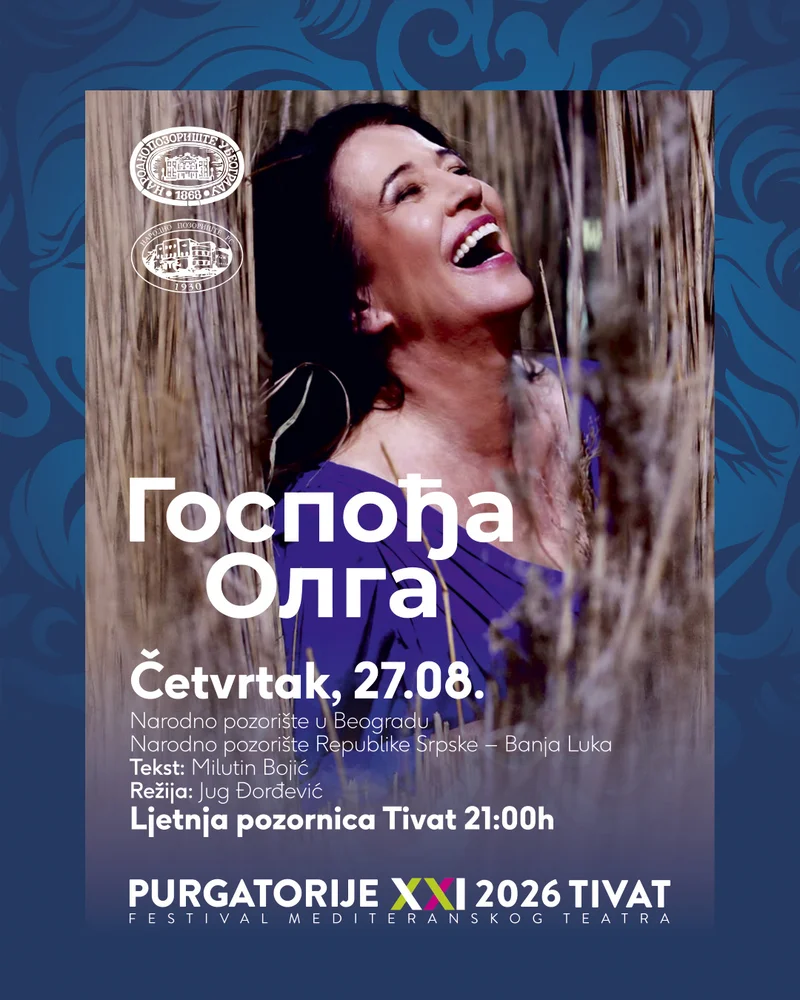
MRS. OLGA – COMPETITION PERFORMANCE
📅 27. August · 21:00
Actors:
- Nela Mihailović
- Ljubiša Savanović
- Slađana Zrnić
- Aleksandar Vučković
- Iva Milanović
- Smiljana Marinković
Authors and production team:
- Coproduction: Narodno pozorište u Beogradu and Narodno pozoriše Republike Srpske
- Text: Milutin Bojić
- Direction: Jug Đorđević
- Dramaturgy: Đorđe Kosić
- Set design: Dragana Purković Macan
- Costumes: Velimirka Damjanović
- Music: Nevena Glušica
- Stage movement: Milica Cerović
- Stage speech: dr Dejan Sredojević
- Lighting: Mia Mlinarević, Srđan Savić
- Producers: Miloš Golubović, Olivera Živković, Nikola Đaković
- Stage managers: Ana Zorić, Vesna Maksimović
- Prompters: Ljubica Raković, Svjetlana Vranjković
- Assistant director: Bojan Stević
- Sound: Velimir Milošević
- Makeup: Marko Dukić
- Stage technology: Ninoslav Stevanović
Bojan Stević is a fourth-year directing student at Akademija umjetnosti UNIBL, in the workshop of Professor Dušan Petrović.
Director’s note
Jug Đorđević notes that the director’s commentary is intended to bring the audience closer to the idea behind the production, but the final interpretation of the performance remains with the public.
At the heart of Milutin Bojić’s play is the theme of a word capable of setting off a chain of events. A secret, confession, silence or suppressed truth becomes the driving force of the story. A single word—for example, “incest,” “illness,” “money” or “honor”—can come at a high cost to the characters trying to hide their secrets.
The production explores what happens when unspoken fears and truths grow into an entire forest that obscures the surrounding world, while death begins to be perceived as a form of deliverance.
Dramaturgical commentary
The question of the genre classification of “Gospođa Olga”
Milutin Bojić’s play “Gospođa Olga” has survived as an unfinished working version. Its premiere at Narodno pozorište u Beogradu was scheduled to take place before the beginning of the First World War, but the final version of the text was lost.
Jovan Hristić called “Gospođa Olga” one of the most significant social dramas in Serbian literature and believed that the play could have marked a turning point in the development of national drama. At the same time, in the early version of the ending, the protagonist Gidra left his family home, rejected a life of compromise and set out to seek his fate on his own. In the surviving version, Gidra stays. His decision is not connected with a moral transformation, but becomes a cynical choice of the familiar and easier path.
This ending calls into question the classification of the play as a social drama. Petar Grujičić draws attention to the lack of principles among the main characters, especially Gidra, and to his attitude toward women, education and returning home. In the researcher’s view, it is precisely this “dark coloring” that makes Gidra a unique character and complicates a traditional genre-based reading of the play.
Milutin Bojić himself defined “Gospođa Olga” as a comedy. However, the themes of incest, illness and blackmail make such a definition difficult. The comic element here may be connected with the weakness, laziness and helplessness of characters who dream of a more dignified life but are unable to change their existence. Their apparently happy ending proves deceptive: Gidra remains unhappy, Vuka marries a man who probably does not love her and may be her brother, while the relationship between Olga and Advokat is destroyed.
The production also examines the play through the lens of naturalistic drama. The characters speak of struggling against their blood, nature and heredity. Extramarital affairs, the question of paternity, incest and money become manifestations of the biological and irrational forces determining the characters’ actions. Their freedom of choice proves illusory, while their fate depends on unconscious impulses.
The question of the genre of “Gospođa Olga” remains open. The final version of the play, which might have clarified the author’s own classification, has been lost.
Schedule
August 2026