
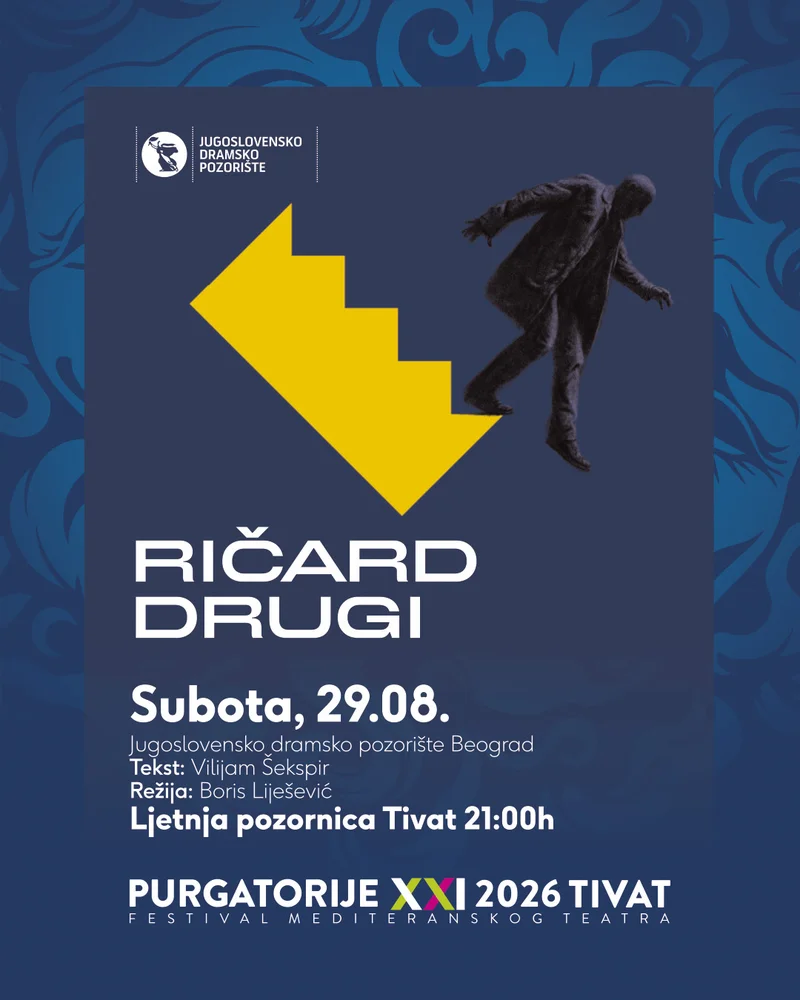
RICHARD II – Competition Performance
📅 29. August · 21:00
ANATOMY OF A FALL
Cast
- Milan Marić
- Vojin Ćetković
- Igor Samobor
- Aleksandar Đurica
- Aleksej Bjelogrlić
- Sanja Marković
- Anđelika Simić
- Danilo Milovanović
Authors and collaborators
- Production: Yugoslav Drama Theatre Belgrade
- Director: Boris Liješević
- Adaptation: Fedor Šili, Boris Liješević
- Dramaturges: Fedor Šili, Vesna Radovanović
- Set designer: Igor Vasiljev
- Costume designer: Marija Marković Milojev
- Composer: LP Duo (Sonja Lončar and Andrija Pavlović)
- Stage movement: Deneš Debrei
- Stage speech: Ljiljana Mrkić Popović
- Lighting designer: Dragan Arsenić
- Sound designer: Bogdan Braković
- Stage manager: Olivera Milosavljević
- Prompter: Goran Mladenović
- Organizers: Andrija Urošević, Viktor Vujić
- Assistant director: Teodora Rakić
- Assistant set designer: Nađa Vukorep
Director’s Note: Boris Liješević
Should we rebel or wait for tyranny to devour itself? How can we preserve our just cause without reaching for something more appealing and more powerful? How can we fight for the same thing without becoming the same as those we are fighting against? How long should we remain silent and wait for a higher power to resolve bloody disputes?
Reading Ričarda Drugog, I finally recognize Šekspira as a contemporary who speaks to us about our time and its events: about a people who always cheer, hate, hope, welcome a new ruler, and see the old one off with hatred, always realizing too late that they failed to react when they should have, instead allowing evil to take root.
The departing ruler finds it difficult to part with power, and in the catastrophe he experiences, he once again takes on human contours and becomes a human being. In his suffering, he can even enchant us, and so we forgive him when we are confronted with the lust for power and arrogance that the new ruler had kept hidden until then. A ruler is always a ruler and never close to the people. The interests of those in power are never the interests of the people. In order to remain in power, a ruler must become alienated from the people, forget them, and relativize the concepts of truth and empathy.
The position of ruler makes him distant, insensitive, and unjust. And we always cast dust on the head of the departing ruler in the same way and cheer “as if the windows themselves were shouting long live the new king,” hoping that in the next ruler we will find a human being. We do not understand that this is impossible, that the role of ruler excludes all other roles within a human being, and that power burns away all other qualities in a person. The crown is a thinking subject that uses its bearer and leads him into madness, only to discard him like a rag. The history of humanity is the history of the struggle for power.
The play does not take the side of one or the other; instead, it confronts us with the futility of rooting for and relying on rulers and their humanity. For everything in their lives and mandates is merely a struggle to remain in power, to serve the crown.
Ričard drugi drew my attention also because of its unusual structure and composition, different from those of Šekspirovi other plays. Reading it, I have the feeling that Šekspir has now directed his panoramic gaze toward the face of the main character and his inner life, toward the way he experiences reality, so that we are watching the anatomy of his fall up close.
Even if its structure is not as perfect as those of the best and most frequently performed plays, what is valuable in Ričardu drugom is its descent into the depths of the human soul, which changes as a result of the catastrophe of losing power, authority, and identity. Šekspir showed us all forms of government, all the patterns, and demonstrated how each of them ends.
Schedule
August 2026